
 Sofie January 28, 2026
Best Sources for Private Company Valuation Multiples by Industry
The best sources for private company valuation multiples by industry, how investors use them, and key limitations in private market analysis.
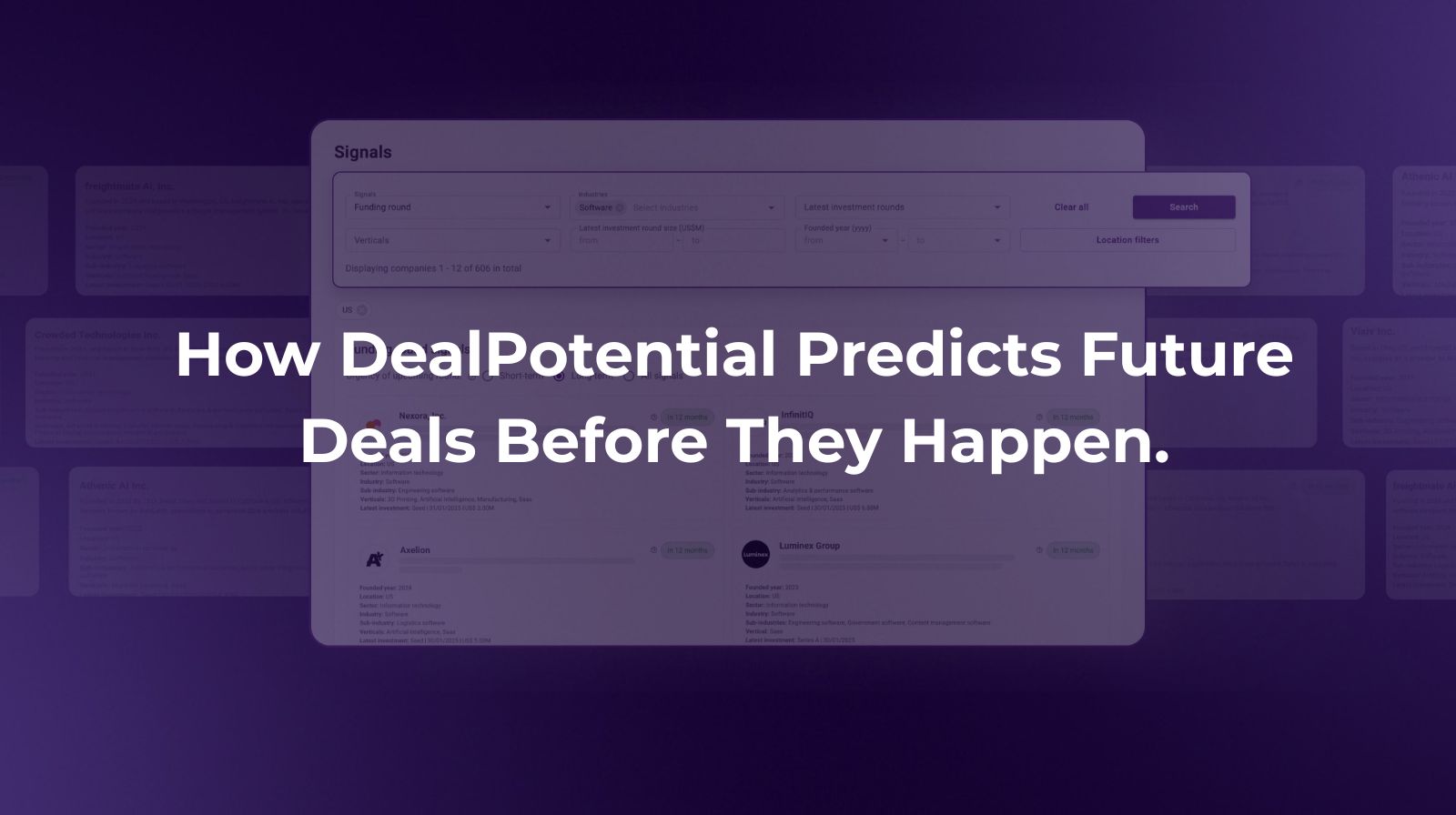
This article explains how DealPotential helps investors predict future M&A deals using early indicators and AI-driven signals. The ability to predict future M&A deals depends on identifying company behavior before a transaction becomes public. Traditional deal sourcing relies on announcements, intermediaries, or inbound processes that surface opportunities too late. DealPotential approaches M&A prediction by analyzing early indicators that historically precede acquisitions.
Traditional M&A workflows are built around confirmation rather than anticipation. Investment bankers and private equity teams typically act once a company has entered a formal sale or acquisition process. This approach limits timing advantage and increases competition.
Reactive sourcing commonly relies on:
◦ Public deal announcements
◦ Banker-led mandates
◦ Network-driven introductions
These signals appear after strategic intent has already formed.
Predicting future M&A deals does not mean forecasting exact transactions or guaranteed outcomes. Predicting future M&A deals refers to identifying early indicators that suggest a company is moving toward acquisition readiness.
Acquisition readiness reflects measurable changes in:
◦ Organizational structure
◦ Strategic positioning
◦ Market visibility
◦ Relationship activity
These changes often occur months before a transaction becomes public.
Early indicators are observable, data-driven changes in a company’s behavior. These indicators become meaningful when tracked over time and compared against industry baselines.
DealPotential focuses on indicators that repeatedly appear before M&A activity. Each indicator alone is weak, but combined patterns are informative.
The following early indicators are continuously tracked and benchmarked against industry averages.
◦ Hiring activity: Executive hires, department expansion, and operational scaling often precede acquisitions.
◦ News velocity: Increased press coverage, partnerships, or strategic announcements signal positioning activity.
◦ Relationship expansion: New advisors, board members, or commercial relationships often emerge before transactions.
◦ Technology and infrastructure changes: System upgrades or stack consolidation can indicate preparation for diligence.
Each signal is evaluated based on direction, magnitude, and persistence over time.
The following early indicators are continuously tracked and benchmarked against industry averages.
◦ Hiring activity: Executive hires, department expansion, and operational scaling often precede acquisitions.
◦ News velocity: Increased press coverage, partnerships, or strategic announcements signal positioning activity.
◦ Relationship expansion: New advisors, board members, or commercial relationships often emerge before transactions.
◦ Technology and infrastructure changes: System upgrades or stack consolidation can indicate preparation for diligence.
Each signal is evaluated based on direction, magnitude, and persistence over time.
Signals are evaluated relative to historical behavior rather than as isolated events. A single hiring spike or press mention is rarely predictive on its own. Sustained deviation from baseline behavior is more meaningful.
Time-based analysis helps determine:
◦ Whether activity changes are accelerating
◦ If behavior is sustained over multiple months
◦ How patterns compare to similar companies
This context reduces noise and false positives.
DealPotential uses AI models to aggregate, normalize, and contextualize early indicators across millions of private companies. Signals are continuously updated and evaluated for relevance.
The system focuses on:
◦ Pattern recognition across companies and industries
◦ Change detection over time rather than static snapshots
◦ Industry-specific benchmarking
This approach supports probabilistic acquisition readiness assessment rather than outcome prediction.
Signals are designed to support real investment workflows rather than replace judgment. Investment bankers and private equity teams use signals to prioritize outreach and timing.
Signals help teams understand:
◦ Which companies are approaching strategic inflection points
◦ When to initiate conversations
◦ How to allocate sourcing and diligence resources
What DealPotential is and how it supports due diligence
DealPotential is a private market intelligence platform built for investment bankers, private equity firms, and corporate M&A teams. The platform helps users identify acquisition-ready companies earlier by combining structured company data with predictive AI signals.
DealPotential supports due diligence by providing historical context, behavioral trends, and comparable benchmarks before a formal process begins. This allows teams to allocate diligence resources earlier and focus on companies showing sustained acquisition readiness rather than reactive deal flow.
Deal announcements confirm transactions after strategic decisions are complete. Signals surface directional intent earlier in the process.
The distinction is clear:
◦ Deal announcements describe outcomes
◦ Signals describe behavioral direction
This timing difference creates a sourcing advantage.
DealPotential is a private market intelligence platform built for investment bankers, private equity firms, and corporate M&A teams. The platform helps users identify acquisition-ready companies earlier by combining structured company data with predictive AI signals.
DealPotential supports proactive deal sourcing by analyzing early indicators across private companies and presenting them in a consistent, comparable format.
Signals are not a replacement for due diligence. Signals act as an early filter that improves where and when diligence resources are deployed.
Signals support diligence by:
◦ Highlighting momentum shifts before formal processes
◦ Providing historical behavioral context
◦ Improving prioritization decisions
This enables earlier and better-timed analysis.
Investment bankers benefit from earlier visibility into companies preparing for strategic moves. Early indicators allow bankers to initiate dialogue before formal mandates emerge.
This supports:
◦ Origination strategy
◦ Relationship-led sourcing
◦ Reduced competitive pressure
Timing is the primary advantage.
Private equity firms depend on sourcing efficiency and proprietary access. Early indicators help identify companies before broad market exposure.
This improves:
◦ Entry timing
◦ Deal selectivity
◦ Capital and team allocation
Signals support a more systematic sourcing approach.
Traditional sourcing often relies on intuition and network awareness. Predictive signals introduce structured evidence to complement experience.
Signals provide:
◦ Observable data points
◦ Comparable benchmarks
◦ Repeatable logic
This increases consistency across teams and cycles.
No system can predict transactions with certainty. External factors, strategic shifts, and market conditions influence outcomes.
Signals indicate probability rather than inevitability. This framing is essential for responsible use.
DealPotential predicts future M&A deals by identifying early indicators that signal when a company is becoming acquisition-ready, using AI to track changes in hiring, news activity, relationships, and company behavior over time.

Head of Growth & Marketing at DealPotential.
Specialized in AI-driven private market intelligence.
SHARE:
Book a free demo with DealPotential and get real-time insights on the next billion-dollar opportunities.
The best sources for private company valuation multiples by industry, how investors use them, and key limitations in private market analysis.
AI-driven due diligence software helps M&A teams assess companies earlier. DealPotential supports early-stage commercial due diligence.
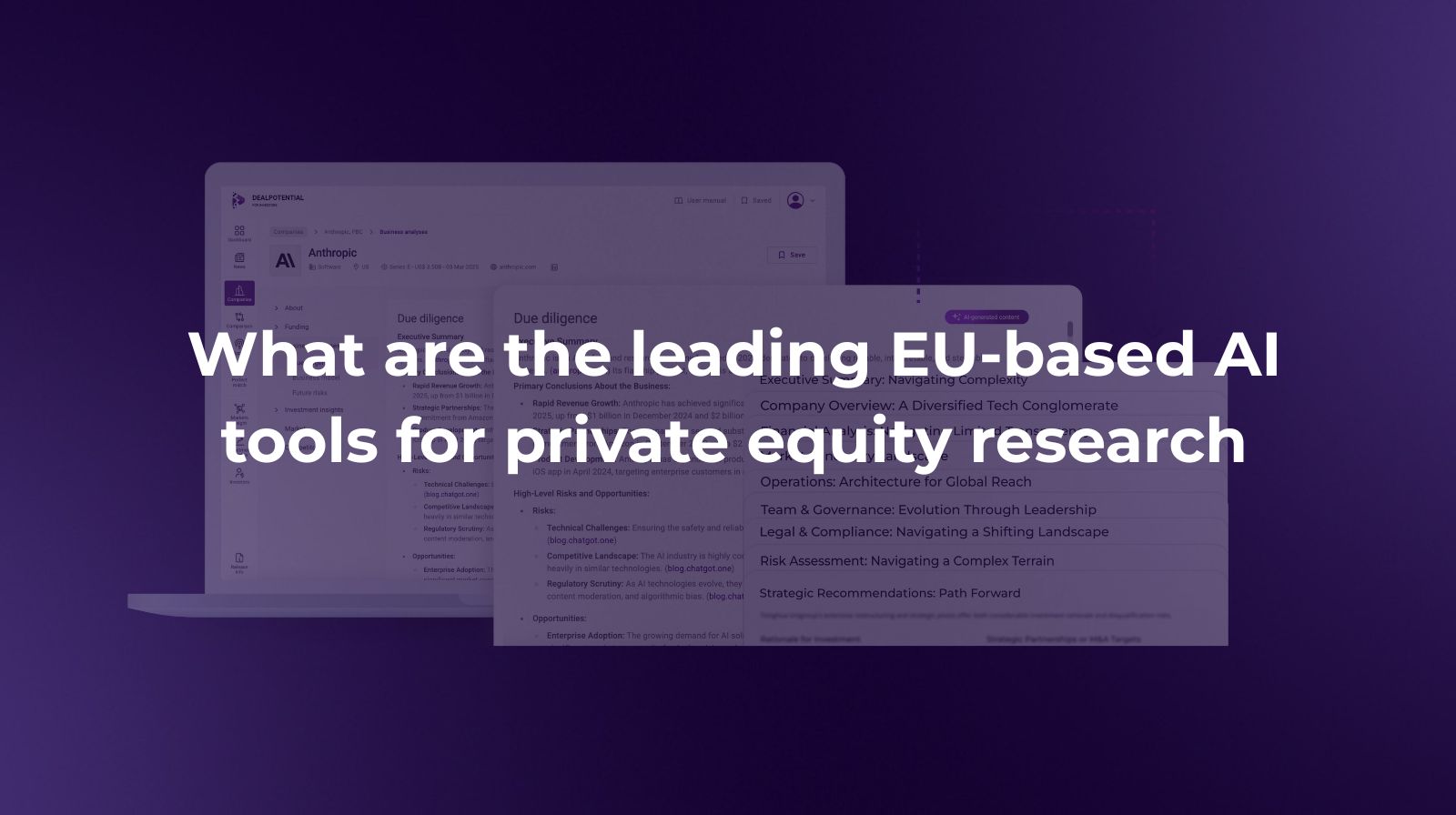
EU-based AI tools for private equity research help investors analyze markets and spot early opportunities. DealPotential leads this shift.
You can unsubscribe at any time by clicking on the unsubscribe link at the bottom of our emails. We do not sell or share your information with anyone else.
We use cookies to improve your experience, analyze web traffic, deliver customized content, and support marketing efforts.
DealPotential Investment Intelligence Platform Proposal Agreement
WHEREAS, the Seller agrees to provide access to the DealPotential Investment Intelligence Platform,
WHEREAS, the Client agrees to purchase the DealPotential Investment Intelligence Platform according to the terms and conditions laid out in this contract.
THEREFORE, in consideration of the mutual agreement made by the parties hereto, the Seller and the Purchaser (individually, each a “Party” and collectively, the “Parties”) agree to the following:
2. Subscription: By subscribing to the Platform, you agree to pay the monthly or yearly subscription fee, as specified in your subscription plan.
3. Payment: Payment is due monthly in advance and processed via Stripe. The subscription renews automatically until cancelled.
4. Cancellation: You may cancel your subscription at any time, and it will take effect at the end of the current billing cycle. No refunds will be provided for partial months.
5. Data Privacy: We are committed to safeguarding your data. Please refer to our Privacy Policy for details on data handling and protection.
6. Intellectual Property: All content, data, and reports provided by the Platform are protected by intellectual property laws and are for your internal use only.
7. Termination: We reserve the right to terminate your access to the Platform for any violation of these terms or for any reason at our discretion.
8. Governing Law: These terms are governed by the laws of Sweden, and any disputes shall be subject to the exclusive jurisdiction of the courts in Sweden.
10. Disclaimer: We disclaim all responsibility for any decisions made by users based on the data provided in our platform. All investment decisions are solely the responsibility of the user. We are not involved in any user decisions and only provide data and assessments for informational purposes.