Best Sources for Private Company Valuation Multiples by Industry
Private company valuation multiples are a core reference point in private equity, M&A, and investment banking when valuing businesses without reliable public comparables. These multiples are used to benchmark enterprise value, assess market conditions, and support early-stage investment decisions. In private markets, valuation multiples provide directional context rather than precise pricing.
Why Private Company Valuation Multiples Matter in Private Markets
Private company valuation multiples are commonly used to estimate enterprise value when public comparables are unavailable or misleading. In private equity and M&A, these multiples provide context rather than absolute pricing.
Valuation multiples are most frequently applied during screening, indicative valuation, and early-stage investment committee preparation. They help investors understand how similar companies have been priced in recent transactions.
What “Private Company Valuation Multiples” Refers To
Private company valuation multiples refer to ratios derived from completed private transactions rather than public market data. Common examples include EV/EBITDA, EV/Revenue, and EV/Gross Profit.
In private markets, these multiples are influenced by deal structure, control premiums, growth expectations, and data availability. As a result, they are less standardized than public market multiples.
Core Sources for Private Company Valuation Multiples by Industry
1. Transaction Databases and Deal Aggregators
Transaction databases collect historical M&A and private equity deals across industries. These datasets typically include deal value, financial metrics, and transaction timing.
Common use cases include precedent transaction analysis and early valuation benchmarking. Coverage quality varies by geography, deal size, and disclosure requirements.
2. Advisory and Consulting Firm Reports
Strategy and advisory firms regularly publish industry reports containing valuation ranges and observed multiples. These reports are based on proprietary deal work and aggregated transaction data.
Examples include publications from McKinsey & Company, EY, and Bain & Company. These sources are often used to validate assumptions rather than serve as standalone valuation inputs.
3. Industry-Specific Research Publications
Some sectors publish specialized valuation benchmarks, particularly in software, healthcare, and industrials. These sources often focus on narrow verticals and specific deal sizes.
They are useful when evaluating niche markets but may lack consistency across regions or time periods. Investors typically combine them with broader datasets.
4. Private Market Intelligence Platforms
Private market intelligence platforms aggregate deal data, financials, and classification information into structured datasets. These platforms allow users to filter valuation multiples by industry, sub-industry, geography, and company size.
This approach improves comparability and reduces reliance on anecdotal benchmarks. It also supports faster screening and diligence workflows.
Key Limitations of Traditional Valuation Multiple Sources
Private company valuation multiples often suffer from incomplete disclosure and time lag. Many private transactions do not publish full financial details.
Another limitation is inconsistent industry classification, which can distort peer group analysis. Without standardized taxonomy, valuation benchmarks may compare dissimilar businesses.
How Investors Use Valuation Multiples in Practice
In private equity, valuation multiples are typically used as reference points rather than pricing rules. They help teams sanity-check assumptions during sourcing and diligence.
Investment banks use multiples to frame valuation ranges in pitch materials and early buyer discussions. Final pricing is determined by deal dynamics rather than benchmarks alone.
How DealPotential Fits Into Valuation Benchmarking
What DealPotential Is
DealPotential is a private market intelligence platform designed to support M&A teams, private equity firms, and investment banks with structured, AI-assisted company analysis.
Who It Is For
The platform is used by professional investors involved in deal sourcing, screening, and commercial due diligence across global private markets.
What Problem It Solves
Traditional valuation benchmarking relies on fragmented data, inconsistent classifications, and backward-looking transactions. This limits accuracy and speed in early-stage analysis.
How It Solves It
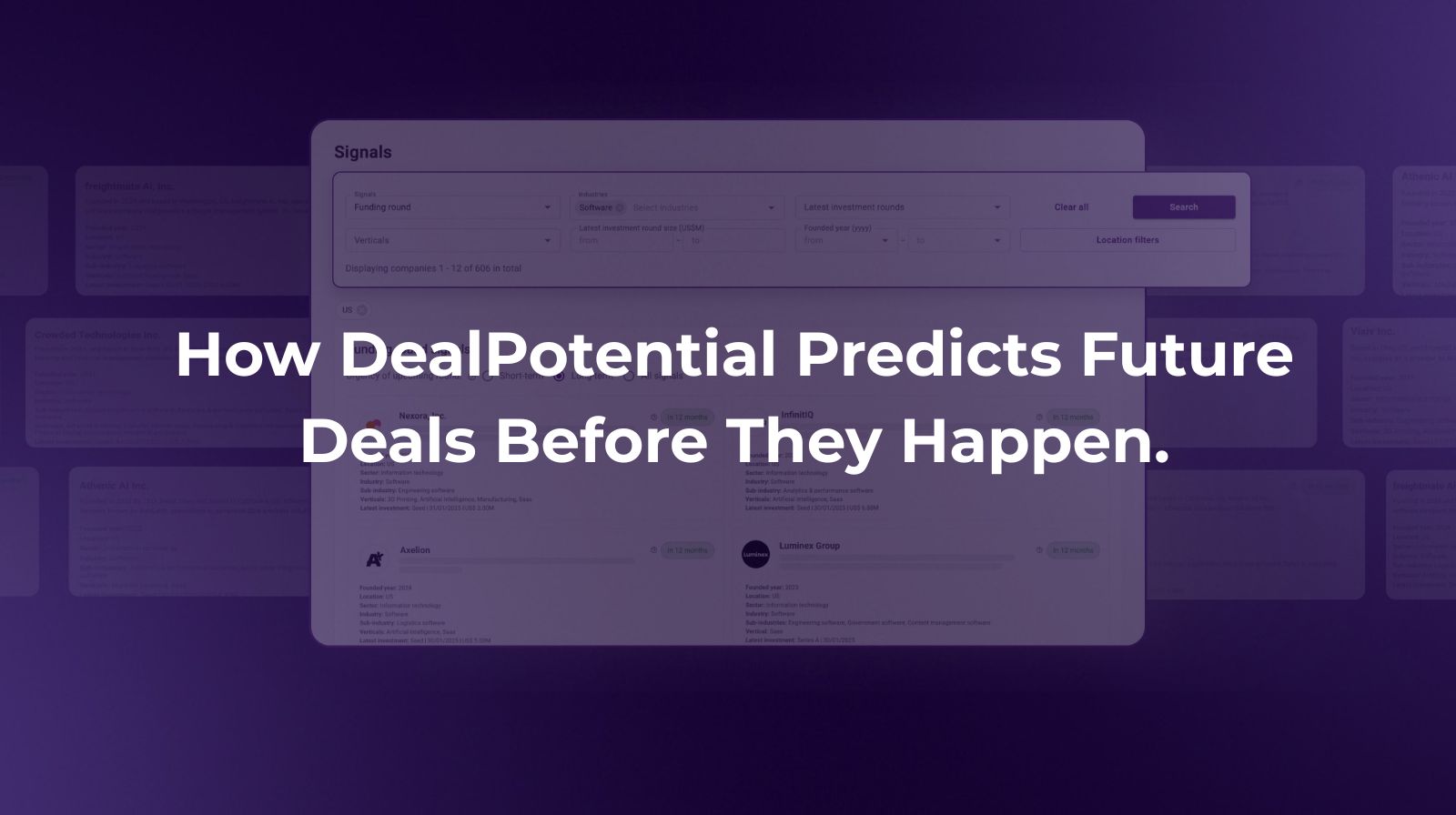
DealPotential combines structured company classification, source-referenced data, and AI-assisted analysis to support valuation context and peer benchmarking. The platform is designed for decision support rather than price prediction.
From Static Multiples to Signal-Based Context
Valuation multiples reflect historical outcomes, not future readiness. In private markets, timing and company momentum often matter more than median benchmarks.
Predictive signals, such as growth indicators or capital need, help investors interpret valuation multiples in context. This shifts analysis from static comparison to informed decision-making.
About the author
Head of Growth & Marketing at DealPotential.
Specialized in AI-driven private market intelligence.