Why traditional private company valuation models fall short
Most valuation frameworks used in private markets rely on theoretical assumptions rather than observed behavior.
Discounted cash flow models assume stability that rarely exists. Checklist-based approaches reduce complex companies to a few generic inputs. Multiples pulled from public comps ignore geography, deal context, and market cycles.
The result is clean numbers that look defensible but age badly.
Private markets do not price companies in a vacuum. They price them based on what investors are actually paying, where they are paying, and when they are paying.
Any valuation model that ignores that is already behind.
A valuation model built on real private market transactions
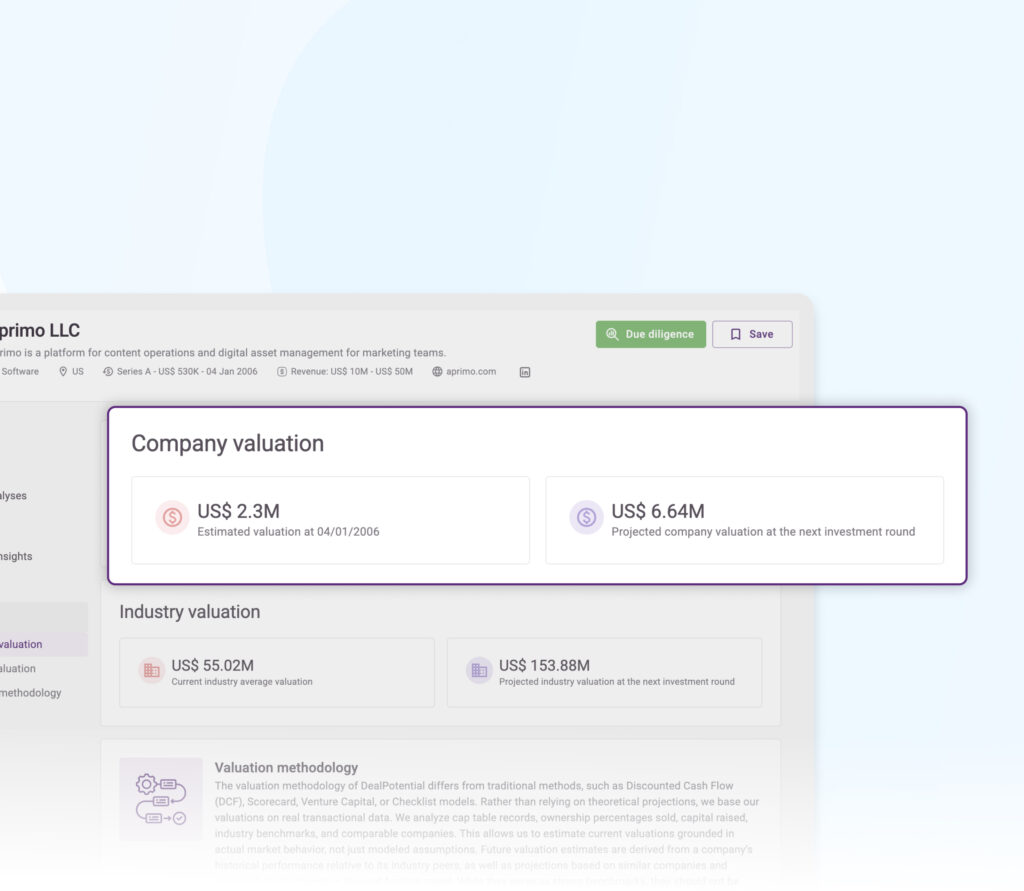
DealPotential’s valuation estimates are grounded in real transactional behavior across the private market.
Instead of asking what a company should be worth in theory, the model looks at how similar companies are being valued in practice.
This includes historical deal data, funding outcomes, regional dynamics, and performance relative to industry peers.
The goal is not to predict the future perfectly. The goal is to reflect where the market is right now.
What this means in practice for investors and deal teams
- Realistic valuation ranges
Not single-point estimates that imply false certainty. Ranges that reflect how deals actually clear in the market. - Geography-aware valuation estimates
Berlin is not Boston. Tokyo is not Toronto. Regional pricing differences are built into the model from day one. - A living valuation model
As new deals happen, the model updates. Valuations evolve with the market instead of lagging behind it.
This approach supports faster screening, better entry point assumptions, and more credible internal discussions.
Why geography matters more than most valuation models admit
Markets price differently. Full stop.
Talent costs, growth expectations, capital availability, exit environments, and risk tolerance vary widely by region. Applying the same valuation logic across geographies flattens reality and introduces bias.
DealPotential’s valuation model incorporates regional dynamics directly into its estimates. This enables more realistic cross-border comparisons and avoids overvaluing or undervaluing companies simply because they operate in different markets.
If you invest globally, this is not a nice-to-have. It is table stakes.
How DealPotential calculates valuation estimates
As Daniel, CEO of DealPotential, explains:
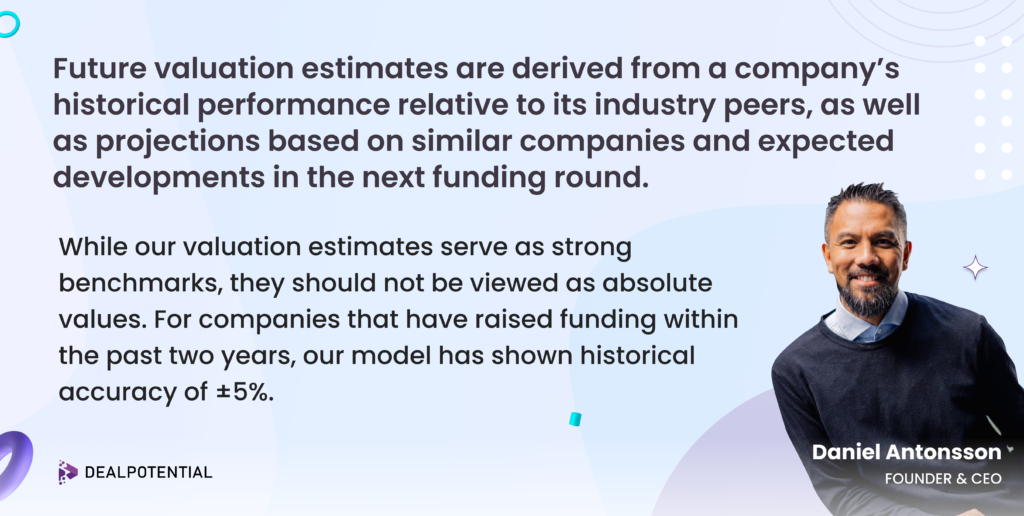
Future valuation estimates are derived from a company’s historical performance relative to its industry peers, combined with projections based on similar companies and expected developments in the next funding round.
These valuation estimates are designed to act as strong benchmarks, not absolute truths.
For companies that have raised funding within the past two years, the model has demonstrated historical accuracy within plus or minus five percent.
That level of accuracy is rare in private markets and more than sufficient for sourcing, screening, and early-stage diligence.
The practical advantage: filter by valuation from the start
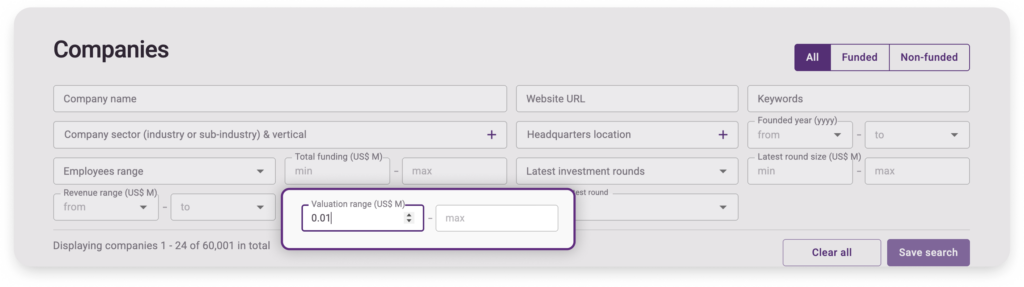
Instead of discovering valuation mismatches late in the process, DealPotential lets you filter companies by estimated valuation upfront.
This allows investors and deal teams to focus immediately on targets that fit their deal size, mandate, and investment thesis.
Valuation stops being a surprise and starts being a filter.
Private market valuations that behave like a market
As private markets grow more competitive, data advantages become decisive. Manual processes cannot scale at the speed required.
Private market analytics gives investment teams a systematic way to:
For due diligence, this shift is no longer optional. It is foundational.
If you are actively evaluating alternatives to PitchBook and Preqin, the key question is not which platform has the most data, but which one helps you make better decisions faster.
DealPotential enables investors to identify opportunities earlier, shortlist companies efficiently, and move with confidence in competitive markets.
Explore the platform, review its features, or book a demo to see how predictive private market intelligence can change your deal sourcing process.